
Why LogBlues
Built for the practice, not the procurement department.
Most practice software was designed for a hospital group, then trimmed until a small clinic could afford a version of it. LogBlues was built the other way round, for the clinic that answers its own phone.
The short version
Four things we do differently.
One price, per practice
$50 a month for the practice, not for each person in it. Your front desk does not cost extra. Per-seat pricing bills a clinic for hiring, which is a strange thing to charge for.
The records are yours
They sit on your machines, in a folder you can point at. The clinic keeps working when the internet does not, and leaving never means asking us to hand your own records back.
The assistant is included
Blues runs on your own computer, so there is nothing to meter and nothing to run out of. No credits, no tokens, no per-message charge, no tier that unlocks it.
HIPAA compliant from day one
Not "HIPAA ready". Records encrypted on your own disk, every access logged, roles that actually restrict, and a signed agreement with anyone who touches anything. It was built this way rather than retrofitted.
Spanish for the people who work here
The whole provider workspace and the printed forms, not just a patient portal. Your front desk can run the software in the language they think in.
The price is on the website
All of it, before you talk to anybody. Every plan, the per-claim cost and the backup allowance are on one page. No demo to sit through, no quote, no call.
Side by side
How this usually goes.
Thirteen questions clinics ask software vendors, with the usual answer and the LogBlues answer side by side.
| Typical practice software | LogBlues | |
|---|---|---|
| Finding the price | Request a demo | On the pricing page |
| How you are charged | Per provider, per seat, often per module | One price per practice |
| Where records live | The vendor’s cloud | Your machines, backed up if you want |
| If the internet drops | The clinic stops | The clinic keeps running |
| AI assistant | Add-on, per-message or per-seat | Included, runs locally |
| What the AI sees | Sent to a model vendor | Never leaves the building |
| Getting started | A multi-week setup project | Nine short screens |
| Contract | Annual, auto-renewing | Monthly, cancel whenever |
| Leaving | Export request, sometimes a fee | The files are already on your disk |
| Your specialty | An empty template you fill in | Arrives stocked: procedures, rooms, equipment, forms |
| Spanish | The patient portal, if anything | The provider workspace and the printed forms |
| If a drive dies | Their backup, on their schedule | Three fail-safes, and a restore you can rehearse |
| Half-finished work | Lost when the screen locks | Kept as you type, private to you |
The part nobody quotes you
What software actually costs a small clinic.
The subscription is the number on the invoice. It is rarely the number that hurts. The real cost is the afternoon spent re-entering a patient who is already in the system, the claim that goes out wrong and comes back a month later, the referral that goes quiet for three weeks because it only ever lived in somebody’s head.
That is what we built against. Not more features — fewer places for the day to fall through.
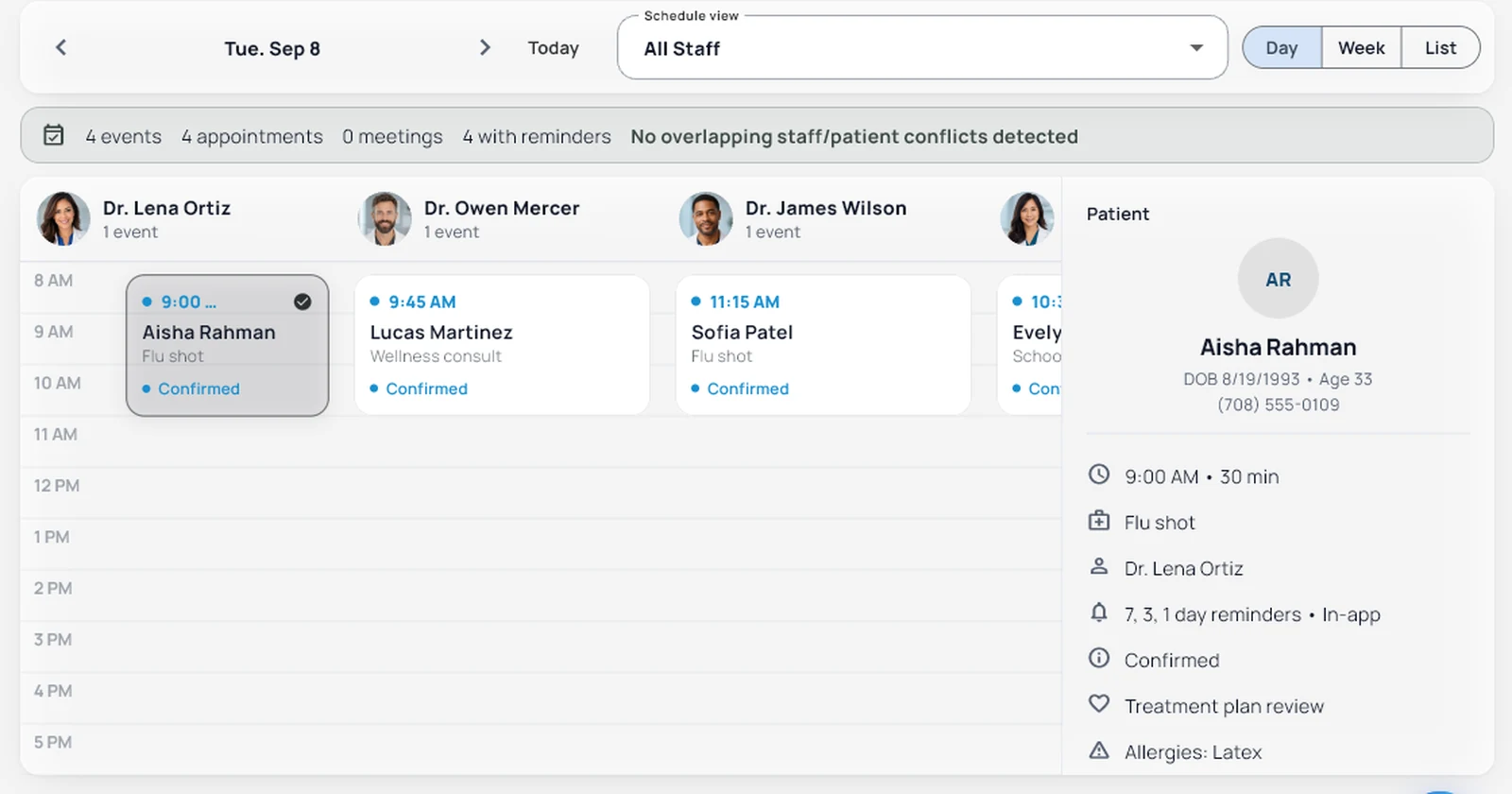
- One record, one place. Book from the schedule, the chart, or the dashboard. It is the same appointment.
- The follow-up is assigned, not remembered. Open referrals come back to a person.
- Codes where the work happens. CPT, HCPCS and ICD-10-CM at the visit, not in a separate program afterwards.
- The chasing is automatic. Reminders, recalls, recurring tasks and reorder points run themselves.
How we compare with other EHR and practice management software →
Since you last looked
What is in it now.
This page used to be four promises. The software has kept going, so here is the rest of it — each one a page you can go and read rather than a line on a feature grid.
Compliance you can hand to an auditor
HIPAA compliance written out, a checklist for a small practice, and policies, procedures and safety checks that arrive filled in for your clinic type.
When something breaks
Three fail-safes between a bad day and a lost record, plus backup and recovery you can rehearse instead of hope about.
Getting paid
Insurance and claims, invoicing, coding at the visit, and a free guide to getting credentialed that we do not charge for.
The day itself
Patient flow so you know who is where, drafts so an interruption costs nothing, and reminders and automations that do the chasing.
The people who work there
Staff and roles, nursing staff, and private team messages that stay inside the clinic instead of a group chat on somebody’s phone.
The assistant, in full
Blues on every plan, a full-screen mode when you want to work with it, and the reasoning for why it never leaves your computer.
Who you are dealing with
A small company, on purpose.
LogBlues is small, and staying that way is the point. You get answers from the people who wrote the code, and your feature request does not queue behind a hospital group’s. It also means we will not pretend to be an enterprise vendor. If that is what you need, they exist and they are good at it.
What we will promise: we answer. We say what the software does and what it does not do yet. And nothing about you or your patients is for sale — not to an advertiser, not to a data broker, not to train a model.
See the plans → Who we build for →Two of those promises have a page of their own: Blues, the assistant that runs on your own computer, and why the AI stays in the building.